Friday, January 12, 2007

Grilles


A new assignment came in weeks ago. It's a residence in Ampang Hilir. Very leafy suburb indeed. A friend of mine and I are doing the landscape works for this double storey bungalow. On one site visit, I stumbled upon these old grilles from yesteryear, chucked albeit neatly into a corner.

I insisted that we ought to keep it. Children of the previous house, and like all things nice about 70's Malaysia, they were easily forgotten and forlorn. I can't easily put it into words - what is it about them which I find so 'poignant'?

Is it nostalgia? Perhaps. When and if you grow up among them, you come to 'see' its use for security and an overlay to the scene which a window captures. Time really affects the mood of the enclosed space. The colour of light and shadows cast from it paint patterns of the outside into the inside.

Otherwise, grilles are also what I'd call iron curtains (pardon the immediate association), and depending on how sophisticated they are, they form a lacey or perforated skin that floats in the air. There's a 'flight' about it, oblivious to the burden of gravity, kind of like the imagination that all designers 'should' and like to have.

History is swallowed into a vacuum


picture taken from badan warisan's website. see also http://www.badanwarisan.org.my/content/?cid=154


Through the decades,
these windows gazed,
through city side walks,
through lives,
we can't imagine.

The world outgrew these eyes,
and through her,
not only riches were turned to ash,
not only for today and tomorrow,
but our conscience too.

And often we wonder,
if the poor are robbed of history,
then who's to know,
if a rich man's fate, even if a name,
were to carry a soul's secret to Hades,
what he owes to me is also lost.

And so I wonder,
a rich man's house...
this one...
what parables you can show us,
to a nation who thirsts...
for a history that she can't make?

...and...
who is left to pick up the pieces,
when we won't know what pieces,
are these of?
when and then we won't.

all that is left,
are the euphemistic tombs,
we won't scarce to forget,
we were bribed by these towers...
Malaysia, this is your tombstone.
and see how they eclipse your memory!

Her shadows!

Thursday, December 28, 2006

Three voices

I had a beautiful image of this. Somehow it got deleted. Picture this...three men arguing persistently on Malaysian affairs while sipping their teh tarik(s) and puffing away with lights.

The smell of cigarettes,
the butts to punctuate...
the three voices speaking for the world.

The anecdotes of life are unveiled in the most unlikely places. And somehow the most poignant stories and inflections of life are exchanged by the most insignificant men. As usual, though common sense is thought to prevail in the highest of places for the betterment of the 'weak', it is 'common' people who are most receptive to it.

Malaysia is oft-known for its tolerance and naivety in the face of rumours. It is not an exaggeration to conclude that many political forces have won and lost battles not through the highly esteemed ballot, but through the approval of coffee shop parliamentarians.

And the site of this daily meeting place is somehow not as sacred as this argument 'hallows' it. The sacred character of common discussion is veiled in the most egalitarian aesthetics. Some call it the kopitiam, for others it is the local mamak joint or merely the shed down the road.

For all its worth these speeches and conspiracy theories are celebrated with the most minimal trappings of high fashion. It is a powerful lesson to designers - in that the most sublime architecture can often miss the point of 'real' life. While designers shouldn't triumph on the laurels of mediocrity, sophistication does not always reside in memory.

It is something to pause and think about. What brings people back to their local kopitiam? Is it sheer necessity or familiarity? Are our old decrepit and sometimes purely 'practical' sheds a jumble of commodities united for the commerce of food and beverage? Are these places memorable?

Sometimes, what's important is not so much how one feels for places (that the relation between activity and emotion can simply be examined in a cause and effect manner), as much as what one actually feels.

Thus, perhaps what is useful to discover is how places feel - when there is a roof over one's head... or how the table looks and feels like when it hasn't been cleaned... or how the thin films of moisture glaze the tables albeit for a few seconds... or how the slight weight of elbows resting shift the legs of the table every few seconds.

And how trees might give too little, too much shade to places...and when torrential rains come to pass, how the iron roofs applaud in thunderous approval...and the new found breeze of fresh moist air is savoured in spaces in between the melancholy and provoking discussions across tables,on these small 'altars' of the world.

Yes, a coffee shop can always be a haunting recognition of the often forgotten world, beyond self, beyond just the unique image of 'architectural' presence.

Monday, December 18, 2006

Bringing immensity to the image

Here is a comment left by one of my readers:

Zhin,

Very interesting comment! Could you elaborate on what you mean by "architectural mood"?

When you say, "the eyes are already in the view," are you saying your photographs are as you would see it if you were physically present at the location?

If not, you'll have to explain that one too. If it's not too much trouble.

It should also be mentioned that if I am allowed to say shit like "brings immensity to the image" too often, I be strung-up for crimes against common sense.


On a lighter note, "bringing immensity to the image" does sound reminiscent of architectural scholarship, I mean 'wank-ship' ( if we could crave for that word). Oddly enough, it does bring to fore an indispensable element of architectural 'production'. When we build, we build according to a vision- an image(s) that maps the intents of our minds and hearts. Thus, it follows that the fidelity to which the act of building adheres to a drawing, a mind map or an image is similarly transferred to the relationship between the image and the atmospheric content that is desired.
Simply put, even the most abstract ideas seem to crave a form of representation that can be experienced, whether in part of fully in the flesh. It sometimes avails to a severe knock in the head when we are anxious to put thought on to paper and yet struggle with the difficulties of translating abstraction to concrete things and vice versa. Nothing new, but it reminds us of the profound reciprocity between the body and the mind, to the extent that denying the realm of the other is negating existence in itself.

Thus, while it is often thought that it is the 'flesh' that matters in the end, many designers are obsessed with image-making, with visions that sometimes seem to bear little resemblance to a finished product. Perhaps I will limit myself henceforth (in this argument) to the theme of veracity (although quite loosely), as this seems to be what bothers or touches most people when they see what I'd loosely call architectural photography.

It isn't really like that!

Well that's true. But then again, what is true about an image goes as far as the eye that sees it. No, I don't mean that people should use their creative licence to lie. From an architect's point of view, 'sometimes' what is in a photograph or in a sketch is what one wants to see. It is sometimes 'permissible', even laudable that one explores not just the truth of what one sees, but how one feels for it.

Architects see things others don't. There is as much creativity in composing a photograph as there is in designing a building. While I acknowledge that there is much window dressing and touching up going out there in the industry there are also many ways of perceiving things beyond the faculties of the eye.
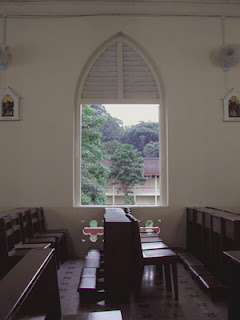


To put this in specific example, I am going to elaborate on a picture taken here as an example.

What did I see? You are most right in challenging the allegation that if architecture is about life, where are the people? But for many architects, the eye is already in a person who sees. None of my pictures are objective viewpoints. Like maps, they are biased in several directions because the creation of the image comes through a mind and body - a subject.

I wanted to explore a feeling of being detached from the world. The sisters in the convent would've looked out that window many times in their life and wondered about their vocation. Were they missing out? And yet the pews were aligned in a completely perpendicular direction. There were two movements that both stretched to eternity and the sisters would've felt the currents each time they stepped into either 'realms'.

The window shown here is in the chapel. It overlooks a field. Kids from the school would've played around each day. Laughters of 'innocence' perhaps, or maybe a false facade, what with the looming towers of hedonism; one on Bukit Nanas and the other two at KLCC so clearly exposed in the background. The force of the world often seems to overpower anything else in its way.

So if you can exercise your imagination, you might perhaps find a sister kneeling on these pews, distressed and at peace each time she does so. Can you feel what she feels? The isolation of the world from her and vice versa. The pain and the ecstasy wrought by merely kneeling on these pews. How her hands and feet might feel and how the ocassional breeze blowing in from the field takes her breath away as she reads the Book of Psalms. And how her fingers seem to feel much older than the year before, joined in prayer, but holding much pain from a world quite indifferent to words like sacrifice and service.

And the pews, never never complain...the world of piety rests on these objects, soaking in the tears, sweat and pain of those who ignore her. For though she is humble, a mere piece of wood, a little sacrament she is too, a pedestal to heaven, where sorrow might meet its rest.

Such dreams are not merely found in cameras Han. They also occur with a mere mild stroke of a pencil. This is why I still keep my drafting desk!

Hope this might prove useful to your deliberations.

Tuesday, December 12, 2006

No news is good news?

Dear friends,

Zhin has been ill for the past week, so he can't write much yet. He's been drinking lots of water and trying to make sure those liquids get to the creative juice cauldron. Please be patient for the next edition. Sorry for the silence.

Meanwhile just to keep you busy - Renzo's going to build something next to darling Corb's Ronchamp Chapel... Does this make you mad?

http://www.guardian.co.uk/france/story/0,,1963339,00.html

Wednesday, December 6, 2006

Nice spaces, bad places


Now, I hope you can guess where this is. One of the many disappointments I have with architecture and urban design in Malaysia, is the lack of places to sit down and do 'nothing'. Yes, nothing is an activity too.

Middle class neighbourhoods such as this one generally have better designed intermediate spaces. But the same problem persists! Where am I to sit down and enjoy the shade provided by the well patronised Bangsar Village? Where are kids to play? Where can teenagers date? Where can I just soak up the sun or watch the world go by?

All nice and glossy, as the sign here suggests, but when you think of it, many so called public spaces are mere dressing or envelope design to make the building 'look' better, to the detriment of real activites. One can do nothing here. What a waste of space, pavement and trees!

Monday, December 4, 2006

Newsflash! Le Corbusier's Chapel Completed


Dear Friends,

Thanks to pushpullbar.com, I got to know about Corb's completed Chapel after 40 years of construction. See links below.

http://www.pushpullbar.com/forums/showthread.php?t=5006

http://www.spiegel.de/international/0,1518,451392,00.html

Enjoy!